
As the main engine of economic growth, the industrial sector plays a strategic role in supporting the national commitment to achieving Net Zero Emissions (NZE) by 2060. Indonesia's industrial sector also has a more ambitious target: reaching net zero emissions by 2050, a decade earlier than the national target.
To achieve this target, the Ministry of Industry has initiated various efforts, such as drawing up decarbonization roadmaps for Priority Industrial Subsectors. It is also preparing industrial emission reduction policies, a Greenhouse Gas (GHG) emission exchange mechanism and carbon economic value for the industrial sector, as well as strengthening the green industry ecosystem and developing the circular economy.
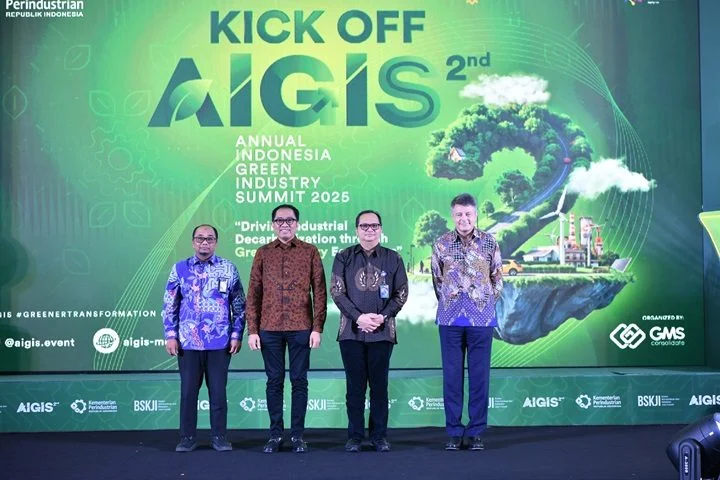
“The transformation of industry toward green industry is no longer an option, but a necessity for the future of our nation and our Earth,” Deputy Minister of Industry Faisol Riza said at the Kick-off ceremony for The 2nd Annual Indonesia Green Industry Summit (AIGIS) 2025 at the Ministry of Industry on Wednesday (18/12).
In 2024, the Ministry of Industry's Center for Green Industry recorded GHG emission reductions in the IPPU sector of 6.92 million tons of CO2eq, exceeding the 2030 Enhanced Nationally Determined Contribution (ENDC) target. Green industry cost efficiency also increased to 7.31% from 6.71%. The number of industrial companies certified to the Green Industry Standard (SIH) has risen every year to 146 companies, and 25 new SIHs were set, bringing the total to 62 standards to date. These are important milestones and targets for the Ministry of Industry.
In September 2024, Kemenperin held the Annual Indonesia Green Industry Summit (AIGIS) in Jakarta. This first AIGIS was an initial step affirming Kemenperin's commitment to strengthening the ecosystem to facilitate the country's green industry transformation through various innovations that support accelerated decarbonization.
In 2025, Kemenperin will again hold AIGIS 2025 with the theme “Driving Industrial Decarbonization through Green Industry Ecosystem”. The AIGIS 2025 Kick-off marks the start of the summit series, while opening space for strategic collaboration between government, industry, strategic partners and international organizations in strengthening Kemenperin's commitment to national industrial decarbonization.
The main AIGIS 2025 event will be held on 20–22 August 2025 and aims to build on the success of AIGIS 2024, which brought together more than 1,000 participants from various backgrounds, from representatives of ministries/agencies, regional governments, development partners, international organizations and industry to experts and academics, both online and offline.
The kick-off of the AIGIS 2025 series was carried out by Deputy Minister of Industry Faisol Riza together with the European Union Ambassador to Indonesia and Brunei Darussalam, HE Denis Chaibi, and the Head of the Agency for Industrial Standardization and Services Policy (BSKJI), Andi Rizaldi.
“The AIGIS 2025 series includes GreenAuto 2025, GreenRun 2025, the Greenphoto Competition and an AIGIS 2025 dissemination roadshow. All events will be held in Jakarta, Bandung, Serang, Surabaya and Semarang,” the Head of BSKJI said.
Another highlight of the AIGIS 2025 Kick-off was the launch of the Green Industry Service Company (GISCO) Preparatory Framework, a strategic initiative designed to accelerate industrial transformation toward sustainability by developing an integrated ecosystem covering financing, technology and other support services.
In addition, the Green Industry Certification Electronic Service System (SELASIH) was launched as part of SIINas, serving as the platform for green industry certification.
On the same occasion, BSKJI also presented the first GHG Emission Validation and Verification Certificate to an industrial company validated and verified by the Ministry of Industry's internal Validation and Verification Body (LVV), and presented certificates of appreciation to 5 (five) industrial companies committed to the National Lighthouse facilitation program for applying the circular economy in industry.
“Kemenperin also signed memoranda of understanding with the World Resources Institute (WRI) Indonesia and the Institute for Essential Services Reform (IESR) at this kick-off. The memoranda affirm strategic collaboration between the parties in drawing up industrial decarbonization studies, as well as studies to increase the competitiveness of national industry in meeting various requirements related to greenhouse gas (GHG) emission reduction, emission disclosure and similar regulations at national and international levels,” the Head of BSKJI explained.
WRI Indonesia Country Director Nirarta Samadhi welcomed the continued commitment of Kemenperin to driving national green industry transformation, especially in the AIGIS 2025 Kick-Off series. Over the past few months, WRI Indonesia has supported the drafting of decarbonization roadmaps for nine industrial subsectors, which also makes a concrete contribution to accelerating national industrial decarbonization.
“Going forward, WRI Indonesia is committed to supporting Kemenperin by providing recommendations on improving decarbonization governance and emission management, as part of efforts to create a more resilient green industry ecosystem so that Indonesia's low-carbon economic growth target is achieved,” Nirarta said.
WRI Indonesia was established in Indonesia under the name Yayasan Institut Sumber Daya Dunia and is an independent research organization dedicated to contributing to Indonesia's inclusive and sustainable socio-economic development. Its work focuses on five portfolios: forests; climate; energy; cities and transportation; and oceans.
Meanwhile, IESR Executive Director Fabby Tumiwa praised the collaboration at AIGIS 2025, saying collaboration like this is crucial in accelerating industrial transformation toward a green economy within the scope of building a green industry ecosystem. “Industrial decarbonization is not only a challenge, but also a great opportunity for Indonesia to become a regional leader in low-carbon industry. IESR is committed to supporting studies, assistance and policy recommendations that help industry adapt to global sustainability standards and increase national competitiveness in the era of the circular economy, industrial decarbonization and energy transformation,” Fabby said.
The Institute for Essential Services Reform (IESR) is an independent think tank focused on the transformation toward a low-carbon economy and a sustainable energy transition in Indonesia. IESR is active in research, policy advocacy and industry assistance in achieving decarbonization. Its activities in cooperation with various policy stakeholders for the industrial sector, including the Ministry of Industry, include drawing up industrial decarbonization roadmaps for priority industrial sectors in Indonesia, supporting the achievement of net zero emissions by 2060 or sooner and the transition to renewable energy, and collaborating with local and international stakeholders to facilitate the adoption of low-carbon technology in industry.
Source: Press Release of the Ministry of Industry of the Republic of Indonesia