

Indonesia is targeted to become the world's halal industry hub by 2024. This vision is strengthened by Indonesia's Muslim population of 231 million, or 85 percent of the country's population. The potential economic value of the halal industry, covering food and beverages, fashion, cosmetics, pharmaceuticals, tourism, media and financial services, will reach IDR 4,375 trillion. The Ministry of Industry (Kemenperin) is focused on developing the domestic halal industry ecosystem.
“One step Kemenperin is taking to support the growth of the halal industry is accelerating the transformation of halal product assurance services,” said the Head of the Agency for Industrial Standardization and Services Policy (BSKJI) at the Ministry of Industry, Doddy Rahadi, in Jakarta on Wednesday (10/5).
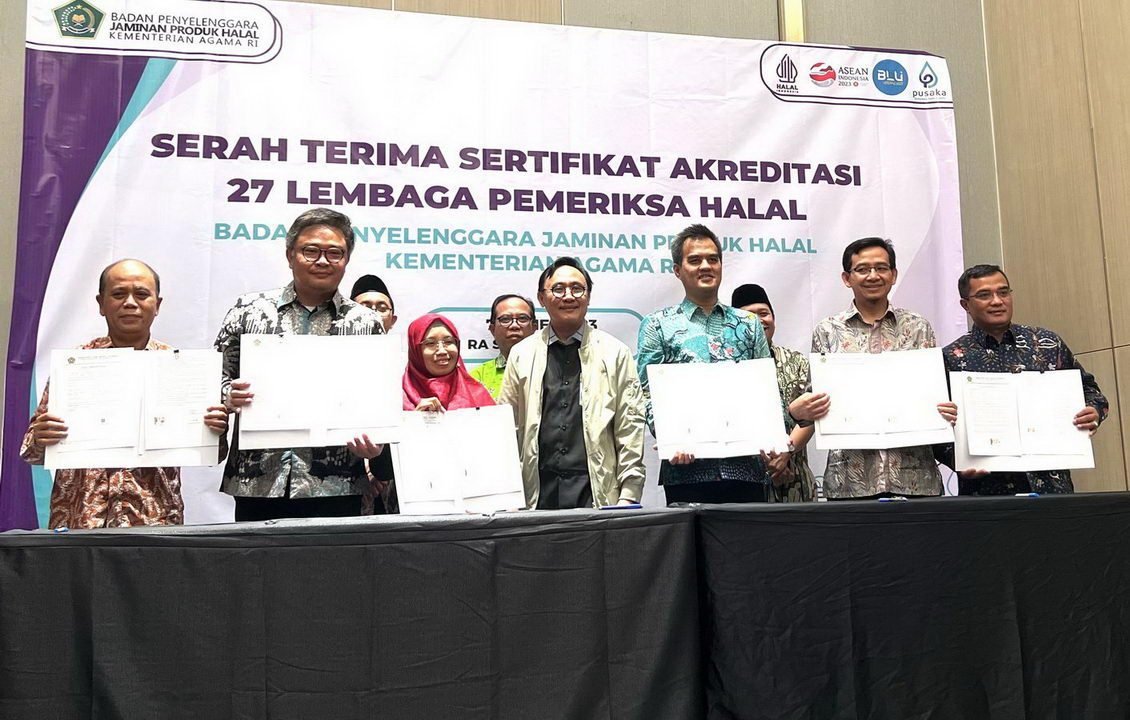
Recently, the Halal Product Assurance Agency (BPJPH) of the Ministry of Religious Affairs presented accreditation certificates to 27 Halal Inspection Bodies (LPH), eight of which are LPHs under BSKJI Kemenperin Technical Implementation Units (UPT).
According to BPJPH Head Muhammad Aqil Irham, these LPHs are expected to be strategic partners of BPJPH in delivering more optimal Halal Product Assurance (JPH) services for businesses in the halal certification process.
“With more LPHs, we hope halal certification services, especially through the regular scheme, become more efficient, cheaper, faster and easier,” Aqil said after presenting accreditation certificates to 27 LPHs in Jakarta on Sunday (7/5).
There are now 55 LPHs across Indonesia helping businesses with halal certification. The number of UPT LPHs within BSKJI Kemenperin has risen to 13.
The Head of BSKJI welcomed the increase in LPHs under BSKJI UPTs. “More LPHs at BSKJI means wider reach for industry to obtain halal certificates, which we hope is a positive sign for achieving the target of 10 million halal-certified products by 2024,” he said.
Doddy and his team are committed to continuously improving the quality of halal inspection services for producers and the public. Standardization and industrial service UPTs in halal product assurance are part of Kemenperin's commitment to fulfilling the legal mandate to strengthen the national economy through empowerment focused on facilitating guidance and supervision of the halal industry.
“The target is for all 24 UPTs under BSKJI to have an LPH, so industry and businesses can more easily access halal certification services and increase their competitiveness,” Doddy said.
The eight LPHs under BSKJI Kemenperin UPTs that have just received accreditation certificates are the LPH of the Center for Craft and Batik Industrial Standardization and Services Yogyakarta, the LPH of the Center for Agro Industrial Standardization and Services (BBSPJIA) Bogor, the LPH of the Industrial Standardization and Services Office (BSPJI) Lampung, and the LPH of BSPJI Surabaya.
Next are the LPH of the Center for Industrial Pollution Prevention Standardization and Services (BBSPJPPI) Semarang, the LPH of the Center for Textile Industrial Standardization and Services (BBPJIT) Bandung, the LPH of BSPJI Palembang and the LPH of BSPJI Banda Aceh.
Previously, five LPHs from BSKJI Kemenperin UPTs had already been accredited: the LPH of the Center for Leather, Rubber and Plastics Industrial Standardization and Services (BBSPJIKKP) Yogyakarta, the LPH of the Center for Plantation Products, Metal Minerals and Maritime Industrial Standardization and Services (BBSPJIHPMM) Makassar, and the LPHs of BSPJI Pekanbaru, BSPJI Banjarbaru and BSPJI Ambon.
Source: Press Release of the Ministry of Industry of the Republic of Indonesia