
The Ministry of Industry continues to accelerate the application of green industry principles in Indonesia's manufacturing sector. Developing this green industry ecosystem is expected to strengthen the growth of the national manufacturing sector so that it becomes more globally competitive, while also preserving the environment and meeting decarbonization targets.
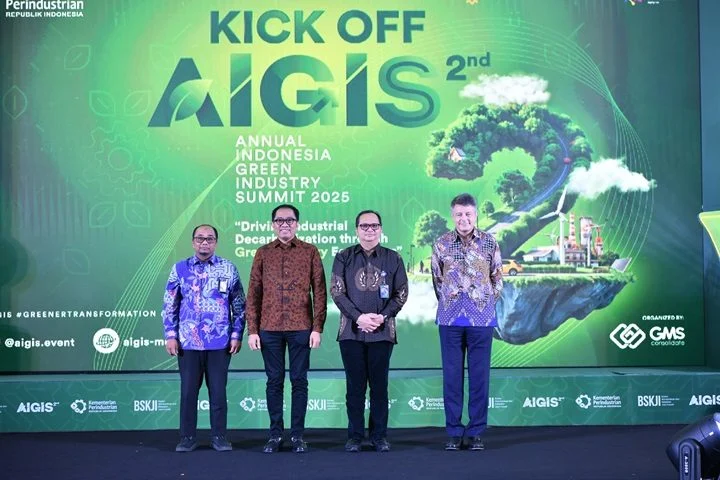
“To achieve sustainable industrial growth, besides prioritizing economic aspects and industrial competitiveness, we need to pay attention to environmental aspects and reduce negative impacts on the environment,” the Head of the Agency for Industrial Standardization and Services Policy (BSKJI), Andi Rizaldi, said at the dissemination of the Pre-Event of The 2nd Annual Indonesia Green Industry Summit (AIGIS) 2025 in Jakarta on Monday (17/3).
The Head of BSKJI said that, as the main engine of economic growth, the manufacturing sector plays a strategic role in supporting the national commitment to preventing environmental damage, including through controlling air pollution and meeting the Net Zero Emissions (NZE) target. “The transformation toward green industry is no longer an option, but a necessity for the future of our nation and our planet,” he said.
Moreover, Indonesia has a strong commitment to supporting global efforts to accelerate the energy transition. This is demonstrated by the Enhanced Nationally Determined Contribution (ENDC) target, the Climate Action Contribution Commitment Document that Indonesia submitted to the international community in 2022.
In that document, Indonesia raised its greenhouse gas emission reduction target to 32 percent, from 29 percent previously, through its own efforts, and to 43 percent with international assistance, from 41 percent previously.
“This means we need to collaborate with all relevant stakeholders to support the development and strengthening of the green industry ecosystem,” Andi said. Through a spirit of collaboration, synergy and innovation, Indonesia is believed to be capable of becoming a real example of developing an industry that is competitive, sustainable and contributes positively to the world.
AIGIS is therefore a strategic platform that can serve as a medium for collaboration among stakeholders to hold dialogue, build synergy and take real action in supporting the transformation of the industrial sector toward greener industry, as well as developing the Green Industry ecosystem as the industrial sector's effort to mitigate climate change.
On this occasion, the Head of BSKJI also introduced Minister of Industry Circular Letter (SE) Number 2 of 2025 on Submission of Industrial Emission Data through the National Industrial Information System (SIINas), as one of the policies to support green industry transformation.
“Through this circular letter, Kemenperin is expected to be able to monitor emissions produced by industrial companies and industrial estate companies, and to guide industry in maintaining air quality, meeting the national greenhouse gas (GHG) emission targets, decarbonizing the industrial sector, and preparing industry for industrial emission reduction policies,” he added.
Meanwhile, the Head of the Center for Green Industry at Kemenperin, Apit Pria Nugraha, explained that AIGIS 2024 successfully became an integrated platform for driving green industry transformation in Indonesia. “AIGIS 2024 attracted various stakeholders, including government, academia, industry, media and others, to support the transformation into greener industry,” he explained.
The various initiatives launched at AIGIS 2024 were widely appreciated, especially in raising awareness of the importance of sustainability and innovation in green industry, and as a forum for collaboration among stakeholders. “To build on that success, AIGIS 2025 marks a major step in the transition toward lower-emission industry, in line with the industrial sector's 2050 Net-Zero Emissions target set by the Government of Indonesia,” Apit said.
AIGIS 2025 is a collaboration among four parties: Kemenperin through BSKJI, the World Resources Institute (WRI) Indonesia, the Institute for Essential Services Reform (IESR), and GMS Consolidate as the event organizer for the entire series of The 2nd AIGIS 2025. The main AIGIS 2025 event will be held on 20–22 August 2025 at the Jakarta International Convention Center (JICC).
Ahead of the main event, various pre-events open to the public will be held. These include the Green Industry Awards,
the Green Journalism Competition and GreenRun.
“The entire series of AIGIS 2025 events is being held without using the state budget (APBN). This is in line with the spirit of collaboration at the heart of AIGIS 2025,” Apit said. With support from various parties, from government and industry to other stakeholders, the series of AIGIS 2025 pre-events will run from March to August.
The Managing Director of the World Resources Institute (WRI) Indonesia, Arief Wijaya, said the collaboration of various parties in the AIGIS 2025 pre-event series symbolizes that the transformation toward green industry is a vision that must be pursued together. WRI Indonesia, as one of the strategic partners of AIGIS 2025, is committed to supporting all relevant parties, from government to industry, so they can move to create a green industry ecosystem.
“As a strategic partner, we play a role in ensuring that the direction of discussion and the impact of AIGIS 2025 are well targeted, science-based and responsive to the needs of the parties involved. That way, AIGIS 2025 can become a platform capable of producing solutions to the challenges of creating a green industry ecosystem,” Arief said.
The program manager for industrial decarbonization at the Institute for Essential Services Reform (IESR), Juniko Nur Pratama, said the success of AIGIS 2025 depends heavily on close collaboration among government, industry, think tanks, CSOs/NGOs, development partners and other stakeholders. “Decarbonization efforts can be likened to a long, winding and steep journey; the vehicles on this journey must have a broad and strong vision, mission and framework,” he said.
Source: Press Release of the Ministry of Industry of the Republic of Indonesia