
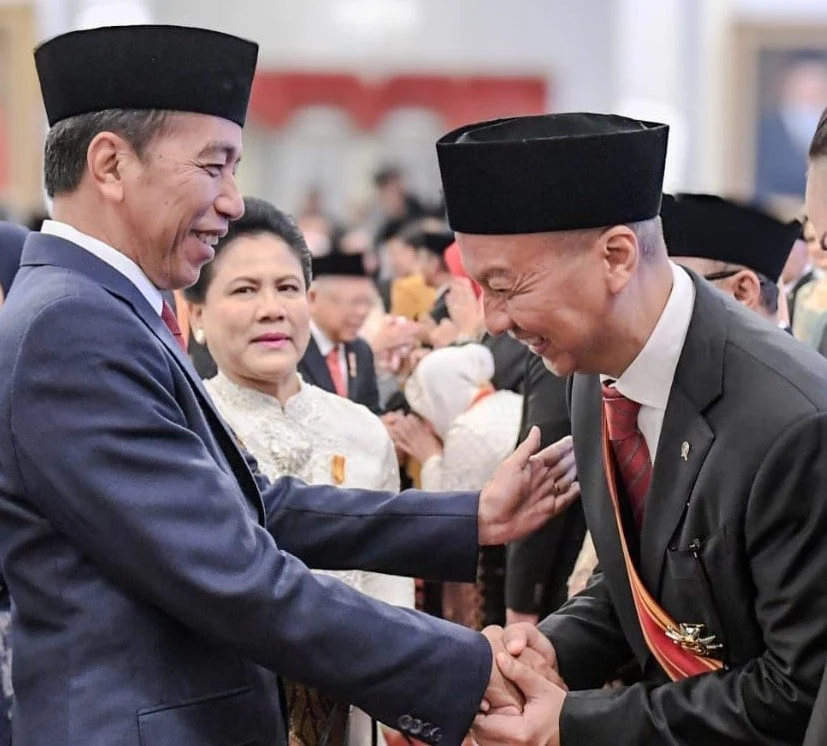
President Joko Widodo raised several industry-related issues at the Annual Session of the MPR and the Joint Session of the DPR and DPD in commemoration of the 79th Anniversary of Indonesia's Independence. This shows that over 10 years the Jokowi administration has been serious about developing manufacturing to boost the national economy.
“President Joko Widodo has proven his determination, commitment and seriousness in building manufacturing to be more globally competitive. We have carried out several of his directions to the Ministry of Industry well, thanks to cooperation, synergy and collaboration with all stakeholders,” Minister of Industry Agus Gumiwang Kartasasmita said in a statement in Jakarta on Friday (16/8).
One such strategic policy is the government's move to increase productivity and added value by no longer exporting raw materials but processing them at home first. “Downstreaming is the key to spurring our economy because it has broad effects, including more jobs and higher foreign exchange from investment and exports,” Agus said.
As the President said, although many other countries have sued, opposed and even tried to thwart Indonesia's efforts to ban raw material exports, Indonesia, as a large and sovereign nation, has not wavered and continues to press ahead in support of the downstreaming policy.
“We know the government has stopped exports of nickel, bauxite and copper ore. This will continue with tin and other potential sectors such as plantations, agriculture and marine resources,” he added.
Kemenperin is implementing the downstreaming policy to encourage the growth of smelter industries that process or refine these mined raw materials. To date, nickel, bauxite and copper smelters have been built, creating more than 200,000 jobs and increasing state revenue by up to IDR 158 trillion over eight years.
“The President stressed that we want the wealth of this country, a blessing from Allah SWT, to be managed as fully as possible for the people's benefit and used to the maximum for their welfare,” Agus explained.
A concrete sign of the government's seriousness is that it has taken back Indonesian assets that had been managed by foreign parties for decades, including Freeport, the Rokan Block and Newmont. “Alhamdulillah, all of them have returned to the nation,” he said.
In his speech to members of the MPR, DPR and DPD, President Jokowi addressed the green economy and new and renewable energy. As the world begins to steer its future toward a green economy, Indonesia does not want to lose momentum, because it has great potential in green energy.
“We have more than 3,600 GW from hydro, wind, solar, geothermal, ocean wave and bioenergy, so we will consistently take part in the world's efforts,” Agus said. Regarding this potential, Kemenperin continues to work to increase the competitiveness of manufacturing that applies sustainability principles. One effort is the green industry policy, which broadly covers the three pillars of sustainability: economic, environmental and social.
“Green industry can also be used as a tool for reducing greenhouse gas (GHG) emissions to meet the set targets,” Agus continued. Kemenperin is therefore accelerating the industrial sector's transformation from conventional industry to green industry by applying Green Industry Standards (SIH).
“Applying green industry is expected to address various future issues and challenges such as climate change and decarbonization,” he stressed. However, the President emphasized that the energy transition must be carried out carefully and gradually, because the energy transition to be realized is one that is just, affordable and accessible to the public.
Digitalization and local products
The Jokowi administration has also been committed to accelerating the adoption of technology and digitalization in all sectors, including manufacturing. This is in line with the Making Indonesia 4.0 priority program launched by President Jokowi in 2018.
“According to the President, ever-wider electrification and internet coverage will support building an ecosystem that encourages digitalization for businesses and the development of startups in Indonesia. This will produce more and more high-quality young entrepreneurs in this country,” Agus explained.
In addition, the President again stressed the importance of using domestic products. Support for domestic products receives special attention by prioritizing spending by the state and regional budgets (APBN, APBD) and SOEs through procurement of goods and services. “As the President said, we want what comes from the people to return to the people and be of maximum benefit to the people,” he added.
To boost the use of domestic products, Kemenperin held Business Matching 2024 in Bali some time ago, recording commitments to buy domestic products in government procurement worth IDR 1,428.25 trillion. This comes from commitments by ministries, agencies and regional governments worth IDR 585.69 trillion and commitments by SOEs worth IDR 842.56 trillion.
“This figure is higher than in the previous period, when commitments reached only IDR 1,157.47 trillion,” the Minister said. Business Matching 2024 drew tremendous enthusiasm, with 4,437 participants, including representatives of ministries, agencies, regional governments (K/L/PD), business entities, associations and industrial companies.
In addition, realized absorption of domestic products reached IDR 213.68 trillion, from K/L/PD realization of IDR 146.94 trillion and SOEs of IDR 66.74 trillion. This is higher than the previous period's realization of IDR 181 trillion. “We are optimistic that this will keep growing and hope it can reach IDR 250 trillion by the end of Q1-2024,” Agus said.
Source: Press Release of the Ministry of Industry of the Republic of Indonesia