

The Ministry of Industry (Kemenperin) remains committed to encouraging the development of the domestic machinery industry. The machinery industry has a vital role in supporting increased productivity and competitiveness of the national manufacturing sector.
“The machinery industry has an important role in the national economy, given its function as capital goods in various sectors, both manufacturing and other sectors,” Minister of Industry Agus Gumiwang Kartasasmita said in a statement on Friday (22/8).
The Minister stressed that the machinery industry not only functions as a supplier of production tools, but also as a main driver of industrial self-reliance. “With domestic machinery available, manufacturers can reduce dependence on imports, increase efficiency and strengthen competitiveness,” he said.
Through Minister of Finance Regulation No. 176/PMK.011/2009 on Import Duty Exemption for Machinery and Goods and Materials for Industrial Development in the Context of Investment, the government seeks to encourage new domestic investment. One incentive that can be granted is an import duty exemption on goods and materials for production for four years according to installed capacity, if the company uses domestically made production machinery accounting for at least 30 percent of the total machinery value.
“From an industrial development perspective, the essence of the incentive policy is to increase the use (demand) of domestic production machinery in incoming investment projects. Through this scheme, industry players are also encouraged to buy (sourcing) machinery or equipment domestically to achieve a machinery use value (TKDN) of at least 30 percent in order to qualify for import duty exemption on industrial raw materials for a period of four years,” said the Director General of Metal, Machinery, Transport Equipment and Electronics Industries (ILMATE), Setia Diarta.
The calculation of the domestic production machinery use value is entrusted to Kemenperin through Regulation of the Minister of Industry Number 82 of 2024 on the Use of Domestically Made Production Machinery in the Context of Utilizing the Import Duty Exemption Facility for Goods and Materials for Production.
“This regulation is the guideline for establishing the calculation mechanism and issuing Domestic Production Machinery Use Statement Letters,” said the Director of Machinery and Agricultural Machinery Industries at Kemenperin, Solehan. He is optimistic that the incentive policy prepared by the government will basically have a major impact on empowering the domestic machinery industry.
“Through Ministerial Regulation 82/2024, the government affirms its commitment to increasing the use of domestic machinery products by providing incentives to user industries in the form of import duty exemptions on raw materials for production,” he said.
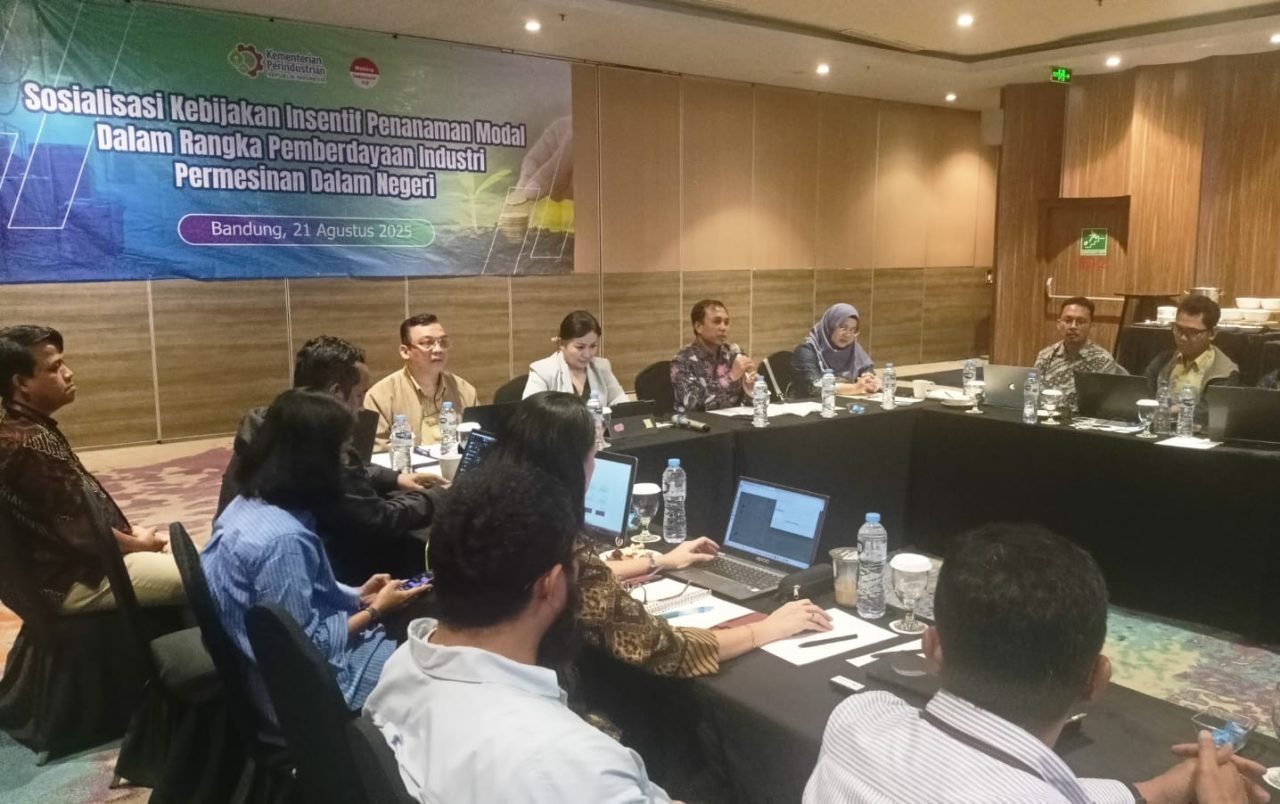
To encourage industry players to optimize these incentives, Kemenperin's Directorate of Machinery and Agricultural Machinery Industries held an Outreach on Investment Incentive Policies for Empowering the Domestic Machinery Industry in Bandung on Thursday (21/8).
Participants came from various industry players and associations, including the food and beverage industry, chemicals and chemical products industry, rubber, rubber and plastic goods industry, machinery and equipment n.e.c. industry, and motor vehicle, trailer and semi-trailer industry.
Based on data from the Ministry of Investment and Downstreaming/BKPM presented at the event, from 2021 to June 2025 only three companies obtained raw material masterlist approval under the TKDN scheme in question (four-year period). This number is still very small compared with raw material masterlist approvals under the non-TKDN scheme, which reached 174 approvals in the same period (two-year period).
Through this outreach, industrial companies are expected to take advantage of the incentive facilities to advance their industries, while encouraging the empowerment of the domestic machinery industry. Moreover, the machinery industry sector makes a significant contribution to the national economy.
Kemenperin records that the machinery and equipment industry grew by 18.75 percent in Q2 2025, its highest growth since 2012. This remarkable achievement was driven by a 30.37 percent increase in government capital spending, which directly boosted production and investment.
Solehan explained that the machinery industry supplies capital goods used in manufacturing production processes. The machinery products produced are diverse, from process machinery, machine tools, heavy equipment and agricultural machinery to energy support equipment.
“The machinery industry is crucial in the manufacturing supply chain to support the processing of raw and semi-finished materials into finished products,” he concluded.
Source: Press Release of the Ministry of Industry