

The Ministry of Industry continues to improve the performance of the textile and textile products (TPT) industry so it can be more competitive amid its problems, including a flood of illegal imports. Sustainability is one of the issues domestic TPT industry must pay attention to and understand, in line with current developments toward an environmentally conscious manufacturing era.
The Head of the Agency for Industrial Standardization and Services Policy (BSKJI), Andi Rizaldi, said sustainability in the TPT industry will support the circular economy and emerging innovation trends. “The TPT industry can explore this potential in terms of product design and specifications, as well as the required industrial standards,” he said in Jakarta on Saturday (16/11).
The national TPT industry now needs to keep improving product quality by applying product quality standards and quality management systems, while observing green industry principles. Green industry standards are proof of the government's commitment to guiding national industry toward sustainable development.
Guidance provided so far covers the selection of raw materials, auxiliary materials, energy, water, production processes, products, packaging, waste and greenhouse gas emissions. Guidance has also been provided at the corporate management level, covering policy and strategic planning organization, implementation and monitoring, management review, corporate social responsibility and employment.
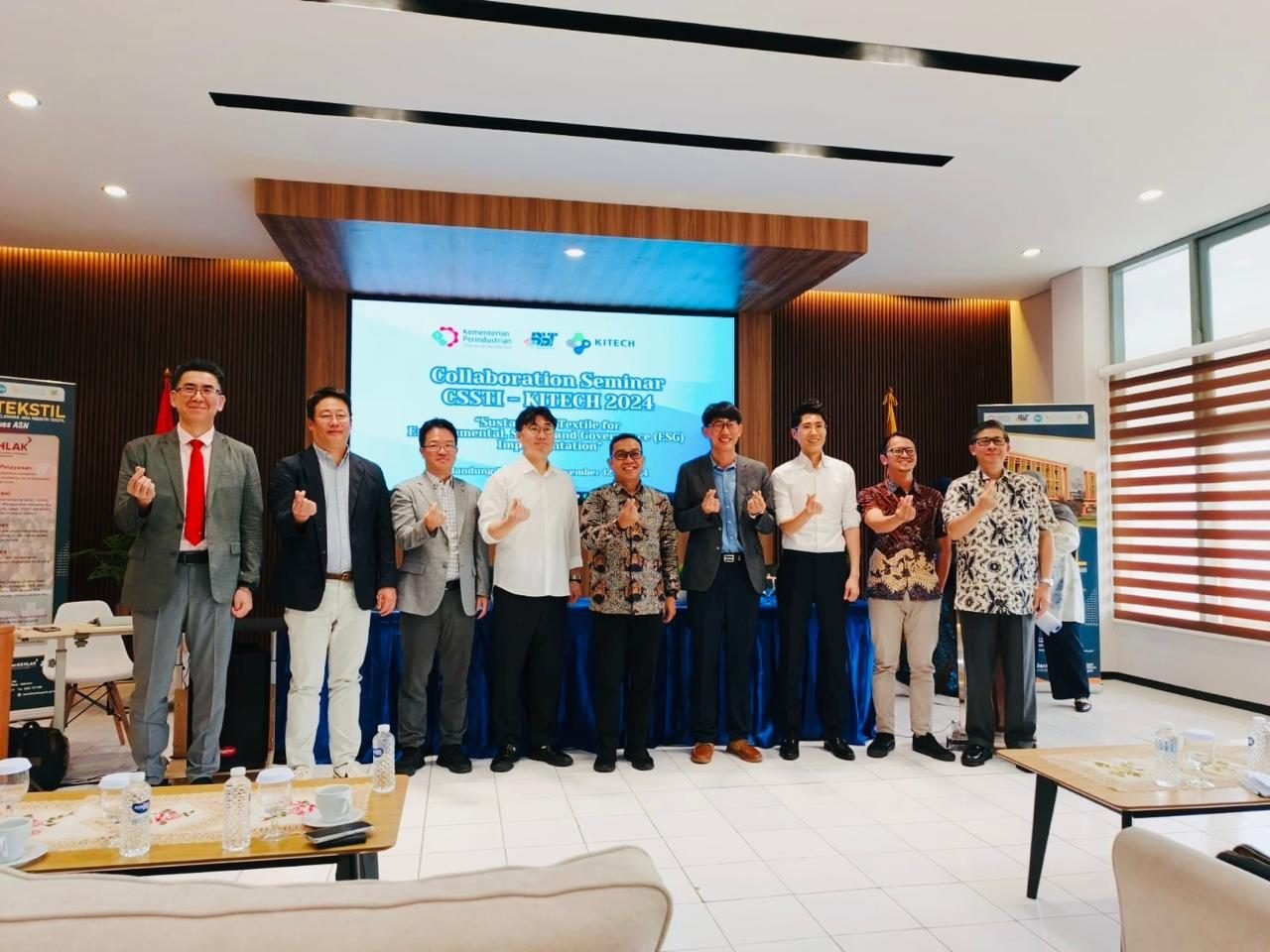
On sustainability, one of BSKJI's work units, the Center for Standardization and Industrial Services Tekstil (BBSPJI Tekstil) Bandung, recently held a seminar titled Sustainable Textile for Environmental, Social, and Governance (ESG) Implementation
. It was attended by 70 representatives of TPT industry stakeholders.
The seminar also closed the series of cooperation activities between BBSPJI Tekstil Bandung and the Korea Institute of Industrial Technology (KITECH) of South Korea throughout 2024. Their technical cooperation covers infrastructure development support, technical consulting assistance, collaborative activities such as seminars, exhibitions and symposia, exchanges of information, technology and experts, and training scholarships.
In 2024, technology exchanges were held twice, in September in Ansan, South Korea, and in Bandung, Indonesia, followed by a collaborative seminar for TPT industry stakeholders featuring South Korean experts from various fields, including the KITECH Textile Innovation R&D Department, the Korea Apparel Testing & Research Institute (KATRI), the Korea High Tech Textile Research Institute (KOTERI), FITI Testing & Research Institute, and the sustainable geosynthetics company Goldenpow.
“The Technology Exchange Meeting was held specifically between the two institutions to exchange the latest information on global issues in the TPT industry and advances in textile technology. By understanding the characteristics of industry in Indonesia, the next collaboration plans can be aligned with industry needs,” Andi said.
Andi also said Kemenperin is actively encouraging the TPT industry to expand market access to potential non-traditional countries. Kemenperin is also helping the TPT industry make use of existing trade agreements.
“Moreover, the TPT and footwear market is projected to grow by 3.17 percent over 2024–2028, with apparel products projected to grow by 2.81 percent,” he said. Meanwhile, revenue is projected to reach USD 798.4 billion by 2028, with Asia the largest market compared with other regions.
“South Korea is currently the third-largest TPT export destination after the United States and Japan, with 2023 exports worth USD 492.77 million and a market share of 4.24 percent,” he said.
Andi added that industry should welcome the export market potential for national TPT to South Korea. “Of course, through efforts to develop local products that can meet international buyers' demands,” he added.
The strategic position of BBSPJI Tekstil Bandung as a Public Service Agency (BLU) unit within BSKJI is therefore expected to keep expanding the scope of its industrial services and complete its quality infrastructure so it can meet global compliance needs.
This is reinforced by the results of a study on developing cooperation for access to international industrial resources carried out by Kemenperin this year, which found that the TPT industry's challenges include gaps in textile technology, research and product innovation that are not yet optimal, and the lack of testing and certification bodies able to meet all the compliance requirements of international buyers, so some services still depend on private bodies abroad.
The Head of BBSPJI Tekstil Bandung, Cahyadi, said his side is actively opening opportunities for international cooperation to accelerate institutional capacity development, especially in line with the organization's duties and functions: industrial services and solutions for increasing TPT industry competitiveness.
“Besides cooperation on technology transfer and exchange of information on industrial standardization, we also continue to complete our quality infrastructure so that industry can more easily test product quality in the country,” he explained.
“As an industrial services provider, BBSPJI Tekstil Bandung sits at the end of the industrial ecosystem, helping provide product quality assurance through testing, inspection, verification and certification, and we hope this can improve the export performance of the domestic TPT industry,” he concluded.
Source: Press Release of the Ministry of Industry of the Republic of Indonesia