
Indonesia's 2022 G20 Presidency is an important and proud moment for industry, as industrial issues will be discussed in more depth, especially in the Trade, Investment and Industry Working Group (TIIWG). The forum is expected to produce concrete steps on implementing cooperation among G20 members and related stakeholders.
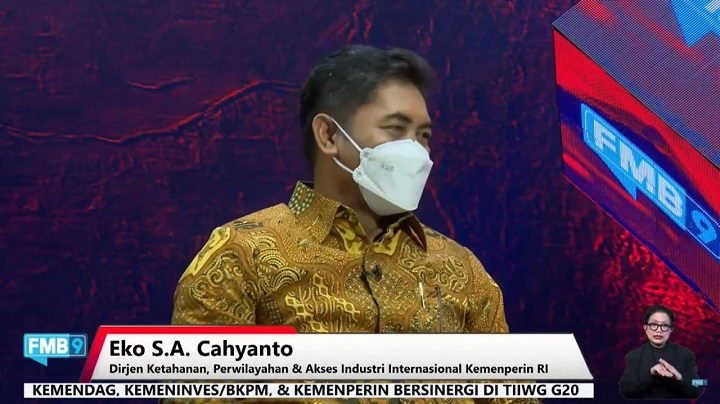
“Indonesia, as one of the world's industrial countries, has the opportunity to pioneer this cooperation, and we hope its results will benefit G20 and other countries, especially developing countries,” said the Director General of Resilience, Regional Development and International Industrial Access (KPAII), Eko S.A. Cahyanto, in Jakarta on Wednesday (23/3).
The Director General of KPAII said Industry 4.0 is an important issue among six priority issues at the TIIWG, especially as digitalization has produced a new generation of production and trade systems. For example, e-commerce has reduced costs in international trade and connected more small businesses and consumers globally.
“Therefore, industrial policy today must take into account modern digital trade and the adoption of digital technology in industry. The impact of digitalization on trade and industry cannot be considered separately,” he said.
Eko explained that digital transformation in manufacturing generally takes the form of new management, business and production models that facilitate innovation and new products. Big Data, Cloud Computing and Artificial Intelligence are no longer the exclusive domain of technology companies. Traditional economic sectors are also seizing the opportunities offered by digitalization to improve production efficiency and competitiveness.
“So the future of growth in the Industry 4.0 era will depend on the level of technology uptake and its application in industry. Unfortunately, the benefits of technological change and digitalization tend to be uneven and enjoyed only among companies within a country,” he said.
Under Indonesia's 2022 G20 Presidency, the G20 TIIWG focuses on the need for an integrated approach to advance Industry 4.0 and facilitate innovation and digital transformation for inclusive and sustainable industrialization. “This approach involves stakeholders in the Industry 4.0 transformation process and aims to create an Industry 4.0 ecosystem,” Eko said.
He said international cooperation will be a key to overcoming these challenges, transforming to Industry 4.0 and driving sustainable economic growth. “The G20 TIIWG opens opportunities to build an ecosystem supporting accelerated Industry 4.0 domestically and internationally, as well as a strong and inclusive Covid-19 recovery,” he added.
The TIIWG has also opened a G20 Dialogue on Industry 4.0 among G20 members to advance inclusive and sustainable industry. The Dialogue on Industry 4.0 could become a main platform for advancing shared understanding of Industry 4.0 issues with representatives from G20 countries across the Industry 4.0 ecosystem.
At a recent FMB9 forum, the Director General of KPAII said the Ministry of Industry will host the first TIIWG meeting in Solo, Central Java, on 30 March – 1 April 2022. Solo was chosen for several reasons. First, it is a city with a long history of past glory, including as a center of industrialization in Java. Over the past decade, industrialization in Greater Solo has been quite massive, and several industries have chosen Greater Solo as their production home base.
“Solo even once had a sugar factory built by Mangkunegoro IV, then the largest sugar factory in the world,” Eko said. At the former sugar factory, known as The Tjolomadoe, there will be a showcase of domestic industrial capabilities.
“The TIIWG meeting in Solo is expected to support accelerating Indonesia's target of becoming one of the world's top 10 economies by 2030. Through this showcase, we can accelerate that target. We hope that with the G20 Presidency in 2022, it can all be realized,” he said.
The meeting is also expected to have a direct impact on local communities. “That is why this event is being held in Solo, whose cultural heritage will attract delegates, rather than in a big city,” Eko explained.
“Government, academia, community representatives and the private sector can share experience, knowledge and views to encourage cooperation to accelerate Industry 4.0 implementation,” Eko said. Through the G20 Dialogue on Industry 4.0, G20 countries will have tools to engage stakeholders, coordinate, leverage synergies, agree on joint actions and create cooperation frameworks to accelerate the transition to Industry 4.0 and more sustainable production patterns.