

The Textile and Textile Products (TPT) industry remains a priority industry supporting the national economy, with exports worth USD 5.76 billion and employing up to 3.87 million people. The TPT industry's performance in 2020–2024 has been heavily affected by factors such as COVID-19, geopolitical and global economic conditions including the Russia–Ukraine war, inflation in the United States and European Union, and the US–China trade war.
Facing the challenge of weakening TPT industry performance due to global conditions affecting demand, the Ministry of Industry has three strategies for textile industry recovery, supported by three main components.
First, creating industrial human resources able to read the direction of competitive and innovative product design. Second, supporting raw material availability and a competitive balance between upstream, intermediate and downstream industries. “Third, reviving the domestic textile machinery industry, which can boost the productivity and efficiency of the national TPT industry to face global market competition,” the Acting Director General of Chemical, Pharmaceutical and Textile Industries at Kemenperin, Reni Yanita, said in a statement on Saturday (31/8).
She added that short-term solutions for the TPT industry include eradicating illegal imports and imports of used clothing, supervising sales of such products on marketplaces and social media, implementing the Domestic Component Level (TKDN) policy in the TPT sector, and actively applying tariff barrier and non-tariff barrier instruments to protect the domestic TPT industry. The TPT machinery/equipment restructuring program also has a positive impact on process efficiency and productivity. In 2024, Kemenperin expanded the industry coverage and budget of the TPT Machinery/Equipment Restructuring Program.
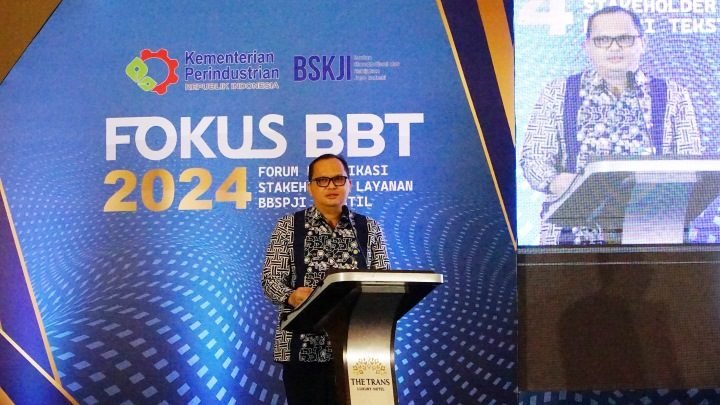
Further efforts to strengthen TPT industry competitiveness are carried out by Kemenperin's Agency for Industrial Standardization and Services Policy (BSKJI) through various industrial development activities, including a Communication Forum held in Bandung some time ago. Attended by around 150 stakeholders representing the TPT industry ecosystem, it discussed strategies to increase competitiveness and create new opportunities to break into global markets.
On that occasion, the Head of BSKJI at Kemenperin, Andi Rizaldi, noted that there are still many opportunities the TPT industry can use. The great potential is in fact the large domestic market, which should be able to boost purchases of textiles and apparel in the country. The policy of applying the Domestic Component Level (TKDN) to government procurement of goods and services has produced significant results. In 2024, capital and goods spending in the state and regional budgets (APBN and APBD) reached IDR 1,223.37 trillion, a market opportunity the TPT industry must seize.
Moreover, under the Sharia Economic Masterplan, the regulation making Halal certification mandatory for consumer goods from October 2026 will open considerable market opportunities in the Muslim market segment.
“Indonesia has the world's second-largest Muslim population, so meeting the need for clothing and other consumer goods whose halal status can be traced will certainly be the first choice of Muslims,” he explained.
BSKJI is also actively formulating Green Industry Standards to ensure quality and compliance with global requirements. Applying green industry principles essentially steers the TPT industry toward a sustainable ecosystem, or circular economy, which is the trend in standards for export commodities.
“Industry players need to know the industrial standards that must be met for export, especially those related to the circular economy. Diversifying industrial products from the circular economy chain will be a tremendous business opportunity,” Andi stressed.
With changing consumer behavior and various global issues, the government's perspective must also adapt nimbly. So too must the Center for Standardization and Industrial Services Tekstil (BBSPJIT), a BSKJI unit that is reinventing industrial services connected with cross-ministry/agency policies and regulations, and becoming an integrated solutions service center as the final link in the ecosystem that brings the TPT industry into global competition.
The Head of BBSPJIT, Cahyadi, said that by transforming into a Public Service Agency, his side will always be a strategic partner for the national TPT industry in achieving competitive advantage.
“We are committed to being a center for information services and solutions for the TPT industry, strengthening cross-institutional connections and collaboration, and helping industry achieve competence and competitiveness through technical assistance,” he said.
New BBSPJIT services now available to the TPT industry include a technical inspection body, halal certification for consumer goods, energy audits, TKDN verification, industrial capability verification, and a melt-spinning testbed facility for developing synthetic fibers from both virgin polymers and recycled fibers.
Source: Press Release of the Ministry of Industry of the Republic of Indonesia