
The Ministry of Industry continues to strengthen the role of industrial standardization as an important instrument for increasing the competitiveness of national industry. Applying the Indonesian National Standard (SNI) can ensure that the quality of domestic products meets domestic market needs while competing at the global level.
“Standardization is also the basis for consumer protection, increased production efficiency and stronger industrial supply chains. With good standards, our industry is not only more competitive, but also more adaptive to the demands of technological, environmental and international trade developments,” Minister of Industry Agus Gumiwang Kartasasmita said in a statement in Jakarta on Tuesday (30/9).
Based on data as of July 2025, 5,449 Indonesian National Standards (SNI) have been drawn up, 136 of which have been made mandatory. The Head of the Agency for Industrial Standardization and Service Policy (BSKJI), Andi Rizaldi, explained that the most common type of SNI drawn up covers test methods, terms, definitions and measurements, accounting for 43 percent of all SNI.
“Next are SNI for products or finished goods, and raw materials. This shows that the scope of industrial standardization is increasingly broad, in line with the needs of industry and the public,” Andi said at the 2025 Industry Gathering of the Center for Metal and Machinery Industry Standardization and Services (BBLM).
Besides formulating and enforcing SNI, BSKJI also carries out standardization surveillance in factories and on the market. This is done in coordination with the ministry responsible for trade and includes supervision of Conformity Assessment Bodies (LPK), which test and issue certificates of conformity.
“In 2024, Kemenperin carried out surveillance of 67 mandatory SNI covering 113 brands in 36 provinces. As a result, 61 brands met SNI requirements, while 51 brands still had notes and findings that need to be followed up,” Andi said.
The Head of BSKJI stressed the importance of cooperation among stakeholders to face standardization challenges. “We cannot work alone. Synergy is needed between industry, LPK, associations, academics and ministries/agencies so that the benefits of standardization are truly felt by the public,” he said.
In this regard, BBLM, which is under BSKJI, is expected to play an active role in supporting the application, enforcement and surveillance of SNI. “BBLM's services must be agile and dynamic, adapting to the needs of stakeholders. BBLM must be present as a partner that provides solutions, while supporting quality assurance for high-quality national industrial products,” he said.
Andi added that strengthening BBLM and other technical implementation units is also in line with Kemenperin's efforts to make SNI a non-tariff barrier instrument to protect the public and national industry amid the flood of imported products. “By building sustainable synergy, we ensure that all industrial standardization policies bring real benefits to industry and consumers in Indonesia,” he added.
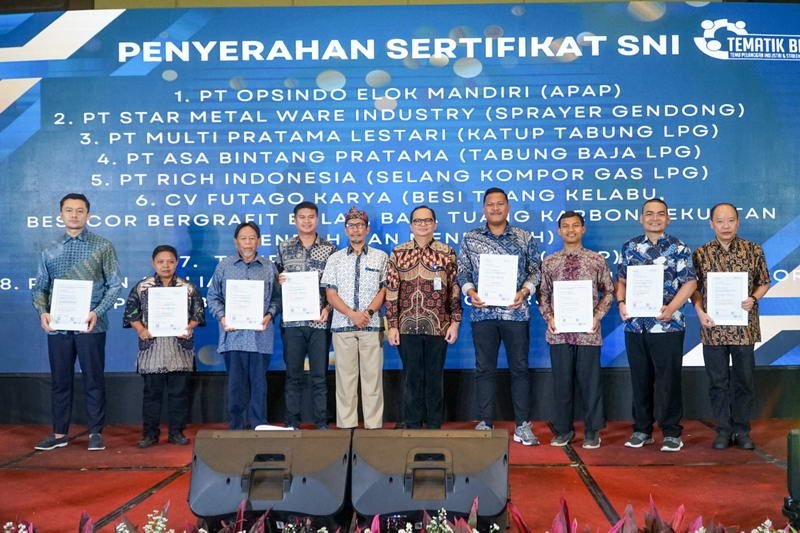
To achieve these goals, BBLM held TEMATIK-BBLM, a gathering of BBLM customers, industry and stakeholders, with the theme “Strengthening BBLM's Synergy with Industry Stakeholders in Facing Global Challenges”. One of the main agenda items was the presentation of accreditation certificates and SPPT SNI certificates, greenhouse gas (GHG) verification, and ISO 9001/14001/45001/ISMS certificates to industries and businesses.
“This moment affirms Kemenperin's commitment to increasing regulatory compliance and the quality of national products, as well as contributing to reducing greenhouse gases as a national program,” said the Head of BBLM, Gunawan.
Through this forum, BBLM wants to ensure that the SPPT SNI certification process in line with regulations can be understood and accessed by all industry players. In addition, the application of TKDN Ministerial Regulation No. 35/2025 is a great opportunity for national industry to strengthen its position in domestic and global supply chains.
Besides outreach on the SPPT SNI certification process, the forum also discussed the implementation of TKDN Ministerial Regulation No. 35/2025, including incentives and the self-declare scheme for SMIs. The forum also gave an overview of mandatory and voluntary product certification for the food tray, agricultural machinery (Alsintan), APAP, energy conversion and metal sectors.
Further sessions covered procedures for submitting GHG emission data via SIINas under the latest provisions, the use of the SIINas digital platform in SNI/SPPT SNI certification services for mandatory products, and solutions to challenges and national issues that all stakeholders must face in synergy, as proof of the active role of all parties.
“We are optimistic that the synergy built with industry stakeholders will be an important foundation for creating a national metal and machinery industry that is highly competitive, environmentally friendly and ready to face global challenges,” Gunawan concluded.
Source: Press Release of the Ministry of Industry of the Republic of Indonesia