

The Ministry of Industry remains committed to applying green industry principles in the manufacturing sector in response to global climate change. Through this commitment, the domestic manufacturing sector is expected to maintain national economic resilience amid the global transition toward a sustainable manufacturing industry.
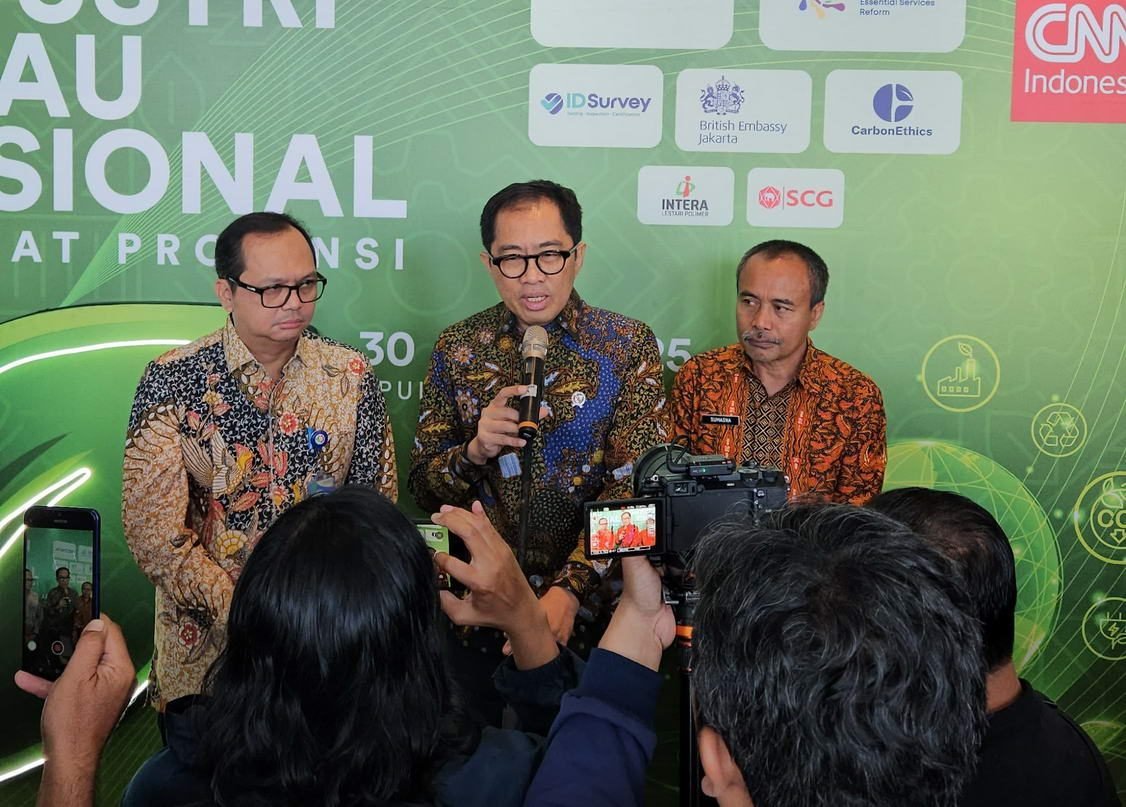
As a concrete step in support of inclusive and sustainable industrial growth, Kemenperin, through the Agency for Industrial Standardization and Services Policy (BSKJI), held the National Green Industry Forum (FIH) 2025 in Bandung. The forum is part of a series of pre-events for The 2nd Annual Indonesia Green Industry Summit (AIGIS) 2025, which will be held on 20–22 August 2025 at the Jakarta International Convention Center (JICC).
“This forum is the starting point for building consolidation, presenting innovation and strengthening commitment toward AIGIS 2025,” Deputy Minister of Industry Faisol Riza said at the opening of the Green Industry Forum 2025 in Bandung on Wednesday (30/4).
According to the Deputy Minister, amid the global climate crisis, demands for resource efficiency and the trend of sustainability-based market globalization, Indonesia must accelerate its move toward green industrial transformation. “With the industrial sector's Net Zero Emission (NZE) roadmap, we are targeting an emission reduction of 31 to 43 percent by 2030 and achieving NZE in the industrial sector by 2050,” he said.
The Deputy Minister stressed that, as a concrete commitment to reducing GHG emissions, the government is revising Presidential Regulation Number 98 of 2021 on the Implementation of Carbon Economic Value (NEK). Kemenperin is also drafting regulations on industrial emission reduction that will apply at the level of processing industry production facilities.
“This policy will regulate the control of air pollutant emissions and the reduction of greenhouse gas emissions, set upper limits for greenhouse gas emissions, establish a mandatory carbon trading mechanism (Emission Trading System/ETS) for the industrial sector, and set a mandatory carbon price,” he explained.
This is in line with this year's Green Industry Forum theme, “Driving Green Industry Implementation in Indonesia”, focusing on accelerating the adoption of low-carbon technology, energy efficiency, applying circular economy principles and strengthening the role of Small and Medium Industries (IKM) in the national green industry ecosystem. The event was attended by more than 300 participants, including representatives of central and regional government, large industry and SMI players, industrial estate managers, industry associations, academics and international institutions such as WRI Indonesia and IESR.
The Green Industry Forum serves as a medium for disseminating green industry policies and a venue for meetings between industry players, academics, regional governments and prospective partners. Various panel discussions at the forum examined strategic approaches to reducing industrial emissions, strengthening the green industry ecosystem and the role of cross-sector policy in encouraging investment in environmentally friendly technology and energy efficiency. FIH 2025 was also a platform for sharing best practices from industry players that have already adopted sustainability principles, such as Jababeka Industrial Estate, PT Gunung Raja Paksi and PT Empat Mitra Indika Tenaga Surya (EMITS).
The forum also highlighted national industrial decarbonization strategies for SMIs. The third session was devoted to “The Green Industry Ecosystem to Drive Sustainable SMI Competitiveness”, featuring speakers from SMIs that have applied green industry principles—such as CV Akasia (a green-industry-certified SMI) and PT Azaki Food Internasional (an export-oriented food SMI)—who shared their transformation experience in applying energy and material efficiency, as well as the Indonesian Batik Artisans and Entrepreneurs Association, which channels the aspirations and needs of other SMIs in applying or transitioning to green industry.
The forum closed with an emphasis that a successful transition to green industry depends heavily on cross-sector collaboration: between central and regional governments, between large and small industry players, and between regulators and supporting institutions. It is hoped that events such as the FIH can become a regular agenda for measuring progress and updating joint strategies in facing the challenges of climate change and global market dynamics.
Source: Press Release of the Ministry of Industry of the Republic of Indonesia