
The circular economy concept is one solution for industry to contribute to sustainable economic growth while considering energy resource availability and environmental impact. The Ministry of Industry (Kemenperin) is therefore actively encouraging industry to apply circular economy concepts, not only large-scale industries but also small and medium industries (SMIs).
“SMIs must be able to adapt to changing market conditions and compete with products made by large industries and imported products. This drives our commitment to keep developing SMIs' potential in Indonesia,” the Director General of Small, Medium and Miscellaneous Industries (IKMA) at Kemenperin, Reni Yanita, said during a working visit to Prabumulih, South Sumatra, on Monday (7/11).
According to Reni, one potential SMIs can develop is exploring local raw materials that are part of regional wisdom, for example making traditional fabrics as an identity and distinctive feature of domestic apparel
products.
“For example, using pineapple leaf fiber, a plant fiber that can be processed into woven fabric or other crafts. In Indonesia, pineapples are widely cultivated in several regions in Java and Sumatra, including Prabumulih,” she said.
The use of pineapple fiber by SMI groups in Prabumulih must continue to be maximized in line with principles of efficient and effective use of sustainable alternative resources. “This is in line with the circular economy or green industry concept promoted by Kemenperin and adapting to the green lifestyle,” Reni said.
Kemenperin, through the Directorate General of IKMA, regularly runs programs to grow and develop new entrepreneurs (WUB) in various regions of Indonesia, including Prabumulih, known for its pineapple natural fiber potential. “Natural fiber is closely tied to the textile and apparel industry, which plays a very large role in the national economy,” Reni said.
Kemenperin noted that the textile and apparel industry grew 8.09 percent in Q3 2022. Textile and apparel exports in January–June 2022 reached USD 7.4 billion, up 26.49 percent from USD 5.85 billion in the same period last year.
Reni said using pineapple leaf fiber as a textile raw material is one example of sustainable fashion in terms of alternative raw materials to increase the future competitiveness of the textile and apparel industry. “Sustainable fashion can also be applied through environmentally friendly rayon fiber, processing plastic waste, and processing raw materials from textile leftovers (yarn or fabric),” she added.
According to Reni, the Directorate General of IKMA continues to collaborate with various parties to develop the potential of pineapple fiber SMIs in the national textile industry so young SMI players become more creative and innovative. “SMIs whose production and promotion systems are still traditional should collaborate with other industries and young designers,” she continued.
Machinery and Equipment Facilitation
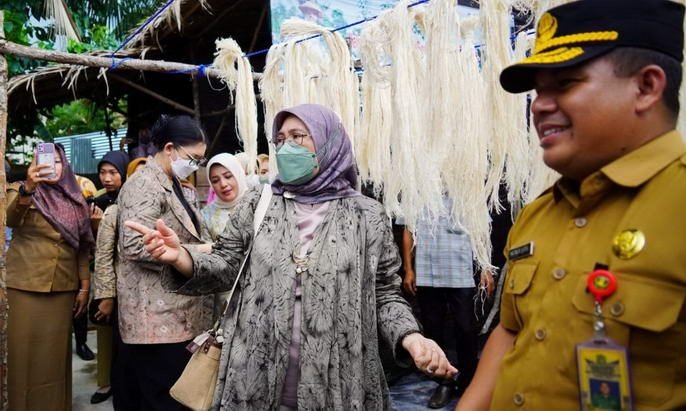
During her visit to Prabumulih, the Director General of IKMA met two SMI groups producing pineapple natural fiber and handed over decorticator machines (natural fiber extractors) to them. The Riyadi pineapple fiber group, with four members, will receive one decorticator, and the Sejahtera pineapple fiber group, with six members, will receive two machines.
“As facilitator, Kemenperin will greatly need regional government support to guide and monitor the development of new SMI entrepreneurs who have been supported through technical guidance training and machinery facilitation,” Reni said.
Santripreneur Program in Prabumulih
On the same occasion, the Directorate General of IKMA also worked with the Prabumulih City Government to run the Santripreneur Program, in the form of technical guidance for new apparel SMI entrepreneurs on 7–10 November 2022. It was attended by 25 participants from Al-Furqon Modern Islamic Boarding School, Darussalam Modern Islamic Boarding School, Nahdatul Ulama Islamic Boarding School and Hidayatul Mubtadin Islamic Boarding School.
The four boarding school groups and one mini-garment group also received machinery and equipment totaling 42 sewing machines and 12 overlock machines. The machinery handover and technical guidance took place at Al Furqon Islamic Boarding School, Tanjung Rambang Village, Rambang Kapak Tengah District, Prabumulih.
Participants also receive material on entrepreneurship, People's Business Credit (KUR) and Business Identification Numbers (NIB), as well as material and practice on developing apparel SMI products. “The government must embrace all stakeholders, such as associations, businesses, designers, academics, influencers, marketplaces and consumers, to build a competitive domestic apparel industry
,” Reni said.
Source: Press Release of the Ministry of Industry of the Republic of Indonesia