

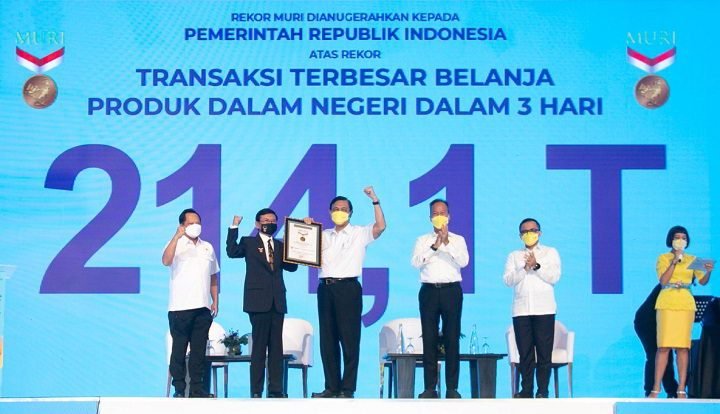
The government successfully held the Domestic Product Spending Business Matching in Nusa Dua, Bali, over three days on 22–24 March 2022, also breaking the MURI Record for the Largest Domestic Product Spending Transaction in three days. By the final day, domestic product spending commitments from central, provincial and regency/city governments reached IDR 214.1 trillion.
Coordinating Minister for Maritime Affairs and Investment Luhut Binsar Pandjaitan expressed appreciation to those who made Domestic Product (PDN) spending commitments through the Business Matching. “Our country is great; today's figure reflects the hard work of leaders of ministries/agencies, regional governments and all involved,” he said at the closing of the Domestic Product Spending Business Matching in Nusa Dua, Bali, on Thursday (24/3).
The commitments are equivalent to 27,707 PDN packages. Through this Business Matching, 978 PDN producers could be involved in state spending. Business Matching is an affirmative step to promote PDN and small and medium industries (SMIs).
“Initially, spending commitments from this event were targeted at IDR 100 trillion, which was exceeded yesterday afternoon (23/3), and they kept rising until today, surpassing IDR 200 trillion,” Minister of Industry Agus Gumiwang Kartasasmita said on the same occasion.
The Minister said Business Matching is not the end of the PDN spending acceleration target. “After this, there will be follow-up Business Matching held physically or virtually, and equally important is supervision and control,” the Minister stressed.
The recent Business Matching is part of a program divided into three stages. “Earlier, a pre-Business Matching stage interconnected data through government applications such as the Ministry of Home Affairs' SIPD, the Ministry of Finance's SAKTI and LKPP's SIRUP, which will connect with the Ministry of Industry's P3DN Information System (SIP3DN),” the Minister explained.
He hopes the domestic product spending commitments recorded over three days will not end on paper, given central and regional government spending potential of IDR 1,071.4 trillion, with IDR 400 trillion that can be absorbed by domestic products and MSMEs.
The Ministry of Public Works and Housing (PUPR) recorded the largest PDN spending commitment in the ministry/agency category, at IDR 43 trillion. DKI Jakarta's commitment in the provincial government category exceeded IDR 5 trillion. In the city/regency category, Bojonegoro Regency committed IDR 1.6 trillion.
To accelerate PDN spending, the Minister said similar Business Matching will be held earlier in 2023 so there is enough time to complete what is needed.
The Minister added that Kemenperin's efforts to support P3DN also include facilitating Domestic Component Level (TKDN) certification for domestic companies. In the 2022 budget year, Kemenperin is providing free TKDN certification for 1,250 product certificates. “We hope regional governments will also budget for TKDN certification, especially for SMIs and MSMEs with local wisdom,” Agus said.
Home Affairs Minister Tito Karnavian said the government has taken imperative steps so it spends on capital, goods and services in the form of domestic products. “This is because the government is the biggest buyer,” he said.
He said all regions must form P3DN Teams under the Joint Circular of the Home Affairs Minister and the Head of LKPP, and allocate at least 40% of their regional budgets (APBD) to domestic products, specifically MSME and cooperative products.
They must also announce all procurement in the General Procurement Plan Information System (SIRUP) no later than 31 March 2022 and fill in e-Contracts in the Electronic Procurement System (SPSE). “Then, require all Regional Government Organizations (OPD) to buy domestic products,” the Home Affairs Minister explained.
The Head of the National Public Procurement Agency (LKPP), Abdullah Azwar Anas, said several regulations that hindered regional spending have been resolved. “So there is no reason for regional governments not to buy domestic products,” he stressed.
To make PDN spending easier, LKPP has simplified the business process for listing products in the National e-Catalog from eight stages to just two, and listing goods/services from nine stages to four. “Together with the Finance and Development Supervisory Agency (BPKP), we are also formulating monitoring at the end of the process,” Azwar Anas said.