
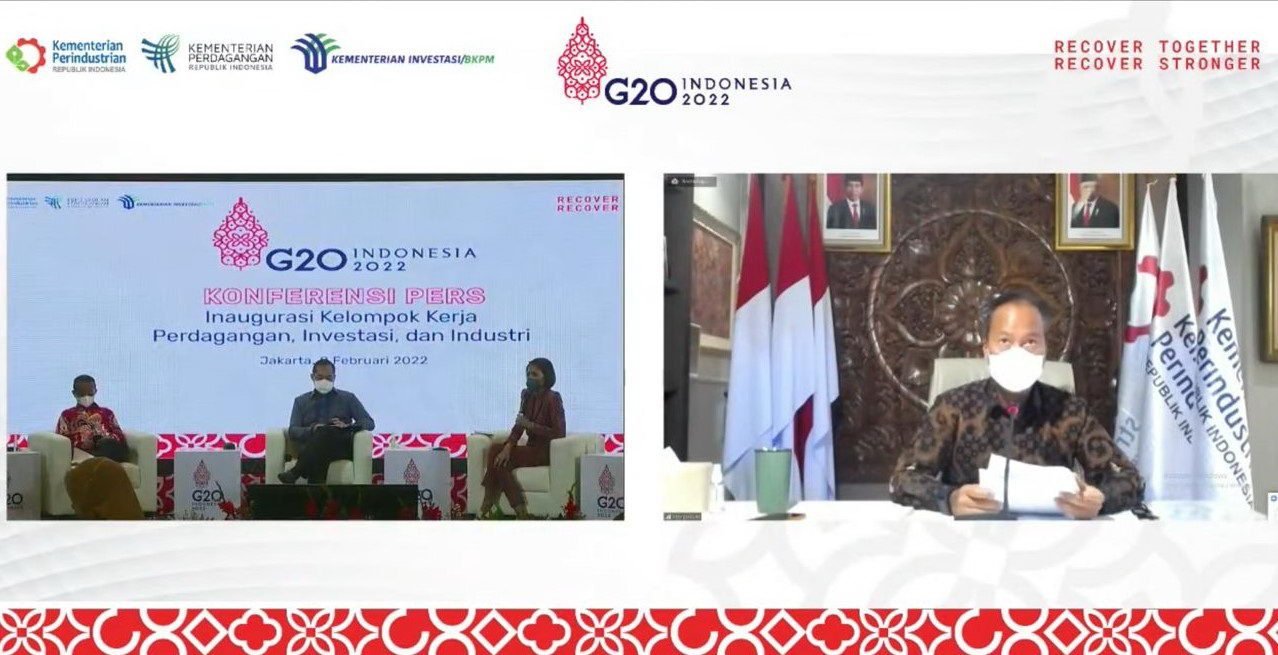
Under the 2022 G20 Presidency, Indonesia as host took the initiative to add industry to the Trade and Investment Working Group, making it the Trade, Investment and Industry Working Group (TIIWG). Although industry is not a new topic and is often discussed, the TIIWG format specifically exists only now.
“Manufacturing supports the economies of many major countries and contributes 14.5% of world GDP. However, the Covid-19 pandemic caused industry worldwide to contract or slow, disrupting global economic activity,” Minister of Industry Agus Gumiwang Kartasasmita said at the Inauguration of the Indonesia 2022 G20 TIIWG in Jakarta on Tuesday (8/2).
The Minister said that with industry formally included in the G20 Presidency's TIIWG, Indonesia is determined to use it by inviting G20 members to collaborate in overcoming pandemic challenges and formulate shared strategies for inclusive and sustainable industrialization, creating a stronger, more resilient economy in the face of crises.
“We believe industry, trade and investment are the three most important pillars and must work in synergy to accelerate economic recovery. Investment is upstream, industry is the intermediate sector, and trade is downstream,” he said.
The Minister is optimistic that investment can build competitive industries, open wider trade access and contribute to the world trading system. “Investment, industry and trade are one chain. They support each other and require excellent cooperation,” he said.
The Minister added that the Ministry of Industry will focus on one issue at this year's TIIWG: Industry 4.0 implementation, to spur inclusive and sustainable industrialization, linked to the broader theme of strengthening achievement of the Sustainable Development Goals
(SDGs) that will affect economic recovery.
“Through discussions among G20 members, we seek to accelerate Industry 4.0 implementation, improve equal access to technology, mitigate negative impacts of technological change, and strengthen collaboration to support inclusive, sustainable industry and global economic recovery,” he added.
Industry 4.0 was chosen because it has potential to increase productivity and competitiveness, reduce energy and resource consumption, and improve resource efficiency and effectiveness. “This can provide significant opportunities for G20 members to increase economic growth while applying sustainable development principles to achieve the SDGs,” Agus stressed.
Many studies also show that manufacturing sectors that have adopted Industry 4.0 are more resilient to crises such as the pandemic. “Accelerating Industry 4.0 implementation can therefore be a solution so industry is ready for possible future crises,” he said.
The Minister also said industry and other sectors responded quickly with digital transformation to face the pandemic. “The Covid-19 pandemic actually pushed industry to accelerate Industry 4.0 through digital transformation in production systems, upskilling, innovation and partnerships with many parties,” he said.
Through the Industry 4.0 issue raised at the G20 TIIWG, the Minister is encouraging accelerated digital transformation and innovation in industry with potential to increase added value, productivity and efficiency. “As part of Industry 4.0, digital transformation also brings new challenges for companies, workers, consumers, governments, research institutions, industry organizations and society as a whole,” he explained.
According to Agus, digital transformation can create new business models requiring adaptation to new work systems and skills, development of standards and policies adapted to digitalization, and social inclusion and equal access to digital technology. “Synergy and collaboration among stakeholders are therefore needed to form an ecosystem where all stakeholders create networks and build cooperation,” he stressed.
International cooperation is therefore a strategic effort. G20 multilateral cooperation will play an important role in overcoming current challenges, leveraging the acceleration of digital transformation due to the pandemic and driving sustainable economic growth. “Through the TIIWG forum, we will encourage G20 countries to discuss strategies to accelerate Industry 4.0 implementation, maximize its benefits and mitigate negative impacts of technological change,” he concluded.
Source: Press Release of the Ministry of Industry of the Republic of Indonesia